Read the texts that changed the world
You can practice Latin, Greek, Arabic, French, or German by studying classic texts. Our goal at CodexTutor is to make learning literary languages more accessible for everyone.
How it works
Read the text, passage by passage
Every text is broken down into digestible passages which are then broken down into even more digestible chunks, making the classics more accessible.
01
Preview Vocabulary
Before you start a passage, review words you haven’t seen in a while in small, bite-sized sessions to prepare you for the real passage.
Deus
God
02
Read the passage, chunk by chunk
Rather than read the whole thing at once, read the passage broken up into meaningful chunks.
قُلْ أَعُوذُ بِرَبِّ ٱلنَّاسِ
Say: I seek refuge in the Lord of mankind
03
Put it all together
Once you have mastered the chunks, you are ready to try reading the whole passage at once.
1ἄνδρα μοι ἔννεπε, Μοῦσα, πολύτροπον, ὃς μάλα πολλὰ 2πλάγχθη, ἐπεὶ Τροίης ἱερὸν πτολίεθρον ἔπερσεν·
04
Vocab Tracking
The app keeps track of what words you encounter, and feeds you vocabulary intelligently based on simple spaced-repetition logic.
The Library
Texts worth a lifetime of study
Read iconic texts in history, science, liturgy, and fiction in their original languages.
Aeneis
The Aeneid
Virgil’s epic of Rome’s founding. The canonical Latin poem, read line by hexameter line.
Latin
Ὀδύσσεια
The Odyssey
‘Tell me of the man of many turns.’ Homer’s tale of homecoming, whole, hexameter by hexameter.
Ancient Greek
القرآن الكريم
The Noble Qur’an
All 114 sūras, from Al-Fātiḥa to An-Nās. The complete text, every word glossed.
Arabic
الأربعون النووية
Forty Hadith of Nawawi
Forty sayings of the Prophet, gathered by a thirteenth-century imam. Most readers enter the hadith tradition here.
Arabic
Magna Carta Libertatum
Magna Carta
The 1215 charter the barons forced on King John. Every constitution since has been written against it.
Latin
Déclaration de 1789
Declaration of the Rights of Man
The 17 articles drafted by the National Constituent Assembly, and the political constitution of the Enlightenment.
French
الجبر والمقابلة
The Algebra of al-Khwārizmī
The ninth-century treatise that gave algebra its name, and taught Europe to do math with letters.
Arabic
Fables choisies
Fables of La Fontaine
The verse fables every French schoolchild memorizes. Animal morality tales as polished as anything in the language.
French
La Parure
The Necklace
Maupassant’s clerk’s wife borrows a diamond necklace, loses it, and pays for ten years. The most perfect short story in French.
French
Ἀπολογία Σωκράτους
Plato’s Apology
Socrates’s defense at his trial, and the founding text of Western philosophy.
Ancient Greek
Τὰ εἰς ἑαυτόν, Α
Meditations
Marcus Aurelius’s private Stoic notebook. An emperor writing in Greek on how to live.
Ancient Greek
Der Erlkönig
Erlkönig
Goethe’s ballad of a father riding through the night as death whispers to his child. The most famous poem in German.
German
Voices across the canon
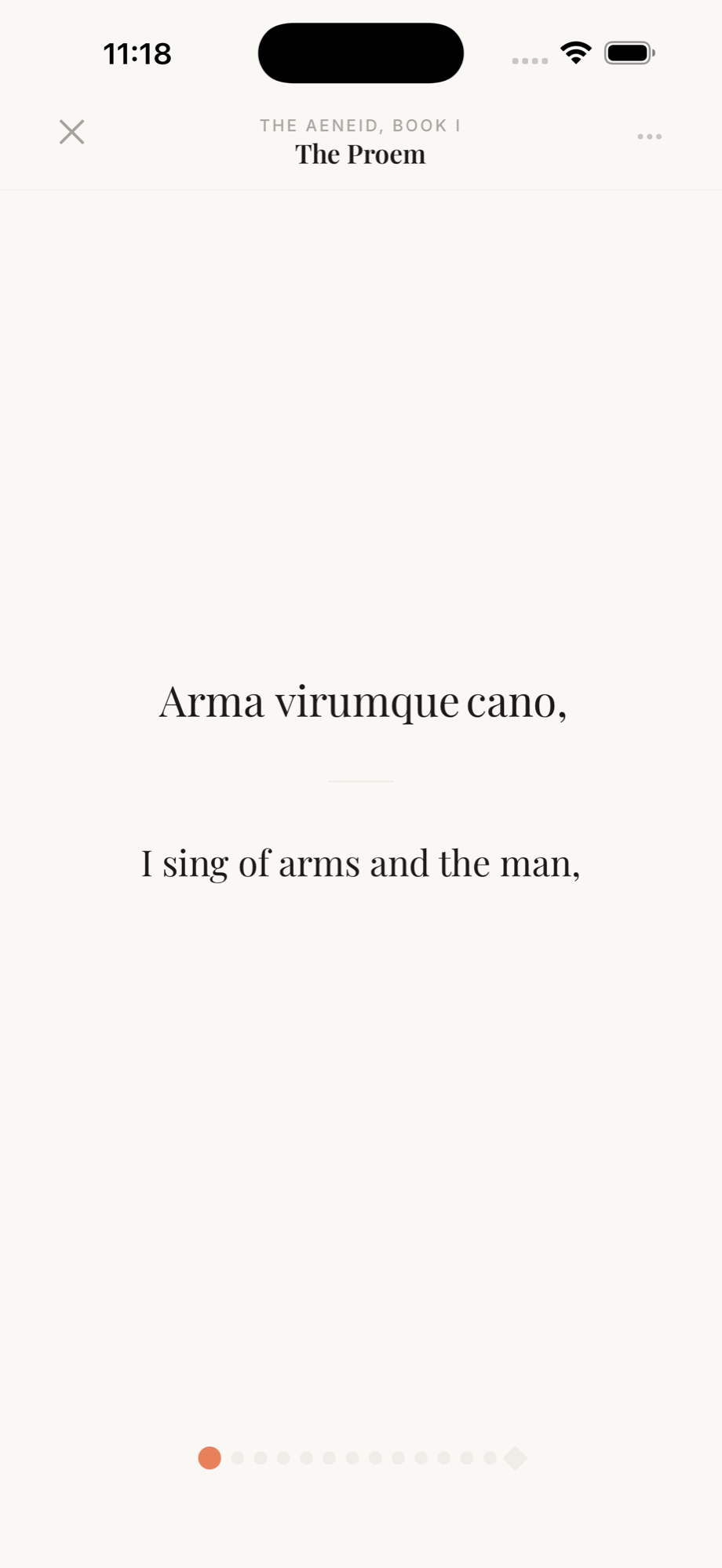
Arma virumque cano
“I sing of arms and the man”
Virgil, Aeneid · Latin
Wer reitet so spät durch Nacht und Wind?
“Who rides so late through night and wind?”
Goethe, Erlkönig · German
اقْرَأْ بِاسْمِ رَبِّكَ
“Recite in the name of your Lord”
Quran 96:1 · Arabic
Les hommes naissent libres
“Men are born free”
Declaration of 1789, Art. I · French
ἄνδρα μοι ἔννεπε, μοῦσα
“Tell me, Muse, of the man”
Homer, Odyssey · Ancient Greek
إِنَّمَا الأَعْمَالُ بِالنِّيَّاتِ
“Actions are but by intentions”
Nawawi, Hadith 1 · Arabic
Read the texts that changed the world.
Study Virgil, Homer, and Goethe, today.
Available on iPhone and iPad.